

We live in an age of body worship. Social media is full of perfect physiques, extreme workouts and personal bests to beat. The message we receive every day is clear: more is better. More weight, more kilometres, more reps.
But there is something that message leaves out: the human body is not a machine, and when it is put under constant demand without proper care, the consequences can be irreversible. We are not talking about holding you back or training less. We are talking about training better, for more years, without an unnecessary injury forcing you to stop.
At Aurum Wellbeing we have spent years working with athletes of all levels — from weekend runners to triathletes — and what we see time and again is always the same: the body warns you long before it breaks. The problem is that we have learned to ignore those signals.
01 — The body we live in
Your body deserves the same care as your performance
We tend to treat the body like a vehicle to be pushed to the limit. But there is one fundamental difference from any machine: when a part breaks, it cannot always be replaced.
Joints, tendons and cartilage are tissues with a very limited capacity to regenerate. A worn knee, a shoulder with an injured rotator cuff or a hip with advanced osteoarthritis are conditions that can change your quality of life forever. And in most cases, they are preventable.
Training without caring for your body is like building without reinforcing the foundations. It works for a while. Until one day the structure gives way.
An athlete’s biggest mistake is not training hard. It is forgetting that caring for the body is also part of training.
02 — What happens to the muscle
Why built-up tension ends up limiting your joints
A muscle that is not cared for gets shorter
When we train hard, muscle fibres contract repeatedly. This is normal and necessary: it is how the muscle adapts and grows. The problem appears when we do not give the muscle the time or treatment it needs to recover.
Fibres that repair without care form tissue that is stiffer and less elastic than the original. Over time, the muscle loses its ability to lengthen, becomes shorter at rest and starts pulling on the structures around it: tendons, joints, capsules.
Imagine a new rubber band: flexible, strong, returning to its shape effortlessly. Now imagine that same band after years without care: hardened, with internal cracks, snapping if you stretch it. That is exactly what happens to a muscle that works but never rests or gets treated.
When the muscle pulls on the joint
This is one of the most common and least visible causes of injury: tight muscles act like cables that compress and misalign the joints. The injury does not come from a single blow, but from years of silent tension.
One of our clients came to Aurum with an overloaded arch that hurt when he ran. He had not been able to train normally for weeks. After a few sports massage sessions working on the sole of the foot, the calf and the hamstrings — the whole posterior chain, tightened by kilometres piled up without recovery — he was able to run pain-free again. In his own words: “I couldn’t be happier after just one week”.
Anyone who trains their quadriceps intensely without working on muscle balance or flexibility creates an unbalanced force on the kneecap. It starts to track badly, the cartilage gradually wears down and, at advanced stages, the damage cannot be reversed. It did not come from an accident. It came from years of untreated tension.
The swimmer’s or weightlifter’s shoulder
Constant shoulder work without joint mobilisation or muscle recovery creates chronic tension in the trapezius and rotator cuff muscles. When those muscles shorten, the space the tendons pass through narrows.
The tendon starts to rub with every movement, becomes inflamed and, if the problem is not dealt with in time, it can end up tearing. Recovery takes months and does not always restore full function. In many cases it could have been avoided with regular muscle recovery and joint mobilisation work.
03 — The performance culture
What we are sold, and what we are not told
The fitness boom has brought wonderful things: more people are moving, eating well and looking for an active lifestyle. But it has also brought a culture of pressure that normalises what should not be normal:
- The “no pain, no gain”, misunderstood, which leads people to train through pain and ignore the body’s signals.
- The pressure to achieve physical results in record time, loading the body before it is ready.
- The glorification of “no days off”, as if resting were a sign of weakness.
- Constant exposure to images of sculpted bodies built at a physical cost that nobody shows on social media.
Tendinitis, overload, fasciitis, muscle tears, premature joint wear. All these injuries have something in common: they are not accidents; they are the result of long-standing tension that nobody treated in time.
Body worship is heavily marketed, body care much less so. And they are very different things.
04 — Stretching is not optional
It is the foundation that supports everything else
There is a widespread idea that stretching is for people who do yoga or who want flexibility for its own sake. Nothing could be further from the truth.
Stretching has a much deeper purpose: keeping muscles at their functional length so that joints can move without compression, friction or premature wear. It is, quite literally, preventive maintenance for your body.
Before training — prepare the body, don’t just warm it up
A dynamic warm-up does more than raise muscle temperature. It activates the synovial fluid, the substance that lubricates the joints and protects cartilage from impact. A cold joint under load is a vulnerable joint.
After training — give back to the muscle what the effort took away
During exercise, the muscle contracts and shortens. If we do not lengthen it afterwards, the muscle starts to “memorise” that shortened position as its normal state. Session after session, the shortening becomes established. And with it, the tension on the joint structures.
The daily habit — the best investment you can make
Ten minutes a day of mobility work and stretching for your most demanding muscle groups is one of the best investments in sporting longevity. You don’t need more. You need consistency.
05 — Active recovery
What happens between sessions matters as much as the training
Recovery is not just the time that passes while you are not training. It is an active process. When muscles work hard, knots form, tension builds up in the connective tissue and areas of hypertonia appear that limit movement and affect the whole muscle chain.
Without treatment, that tension becomes chronic. What started as a small overload in the calf turns into knee pain. What was tension in the trapezius ends up as headaches or reduced shoulder mobility. The body is an integrated system, and tension in one spot has a knock-on effect.
Circulation-boosting techniques bring more blood and oxygen to overloaded muscles. The passive stretching and joint mobilisation done during the session help the muscle recover its resting length, improve its elasticity and relieve pressure on the joints. The result: less stiffness, greater range of motion and a body better prepared for the next workout.
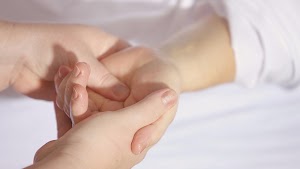
Making sports massage part of your routine is not a whim or a luxury. It is part of the body care that any active person should include as naturally as training or nutrition.
The difference between people who keep doing sport for decades and those who get injured again and again is not just talent. It is how they look after their body between sessions.
Sports massage
Tailored to prepare and recover your body
At Aurum Wellbeing we have spent years working with active people who really want to look after their bodies. We are not a chain or a one-size-fits-all service: each sports massage session is tailored to you, your most demanding muscle groups, your activity and how your body feels that day.
We use circulation-boosting techniques, passive stretching and joint mobilisation to release deep tension, improve tissue elasticity and prepare the body to perform better and more safely. We work on both pre-training preparation and post-exercise recovery, because both phases are equally important.
If you carry tension in your back, neck or legs, or notice that your mobility has been decreasing over time, now is the time to do something about it. Your body is the only one you have, and it deserves to be cared for as seriously as you train.
To sum up
Train smart. Look after your body.
Sport is one of the best things you can do for your physical and mental health. But like any practice that demands a lot of the body, it also requires giving back what you ask of it. Training without recovering is like withdrawing money from an account without ever paying in. Sooner or later, the balance hits zero.
Tight muscles restrict joints. Compressed joints wear out. In many of the body’s tissues, that wear cannot be reversed. This is the silent path that leads to many surgeries that could have been avoided.
Stretch. Rest. Look after your tissues. Listen to what your body is telling you before it has to shout. Because the body we live in has no spare parts, and it is the only one we have for life.
Sports massage
Muscle care
Stretching
Muscle recovery
Sports wellbeing
Massage Barcelona
Aurum Wellbeing




Leave a Reply
Want to join the discussion?Feel free to contribute!